

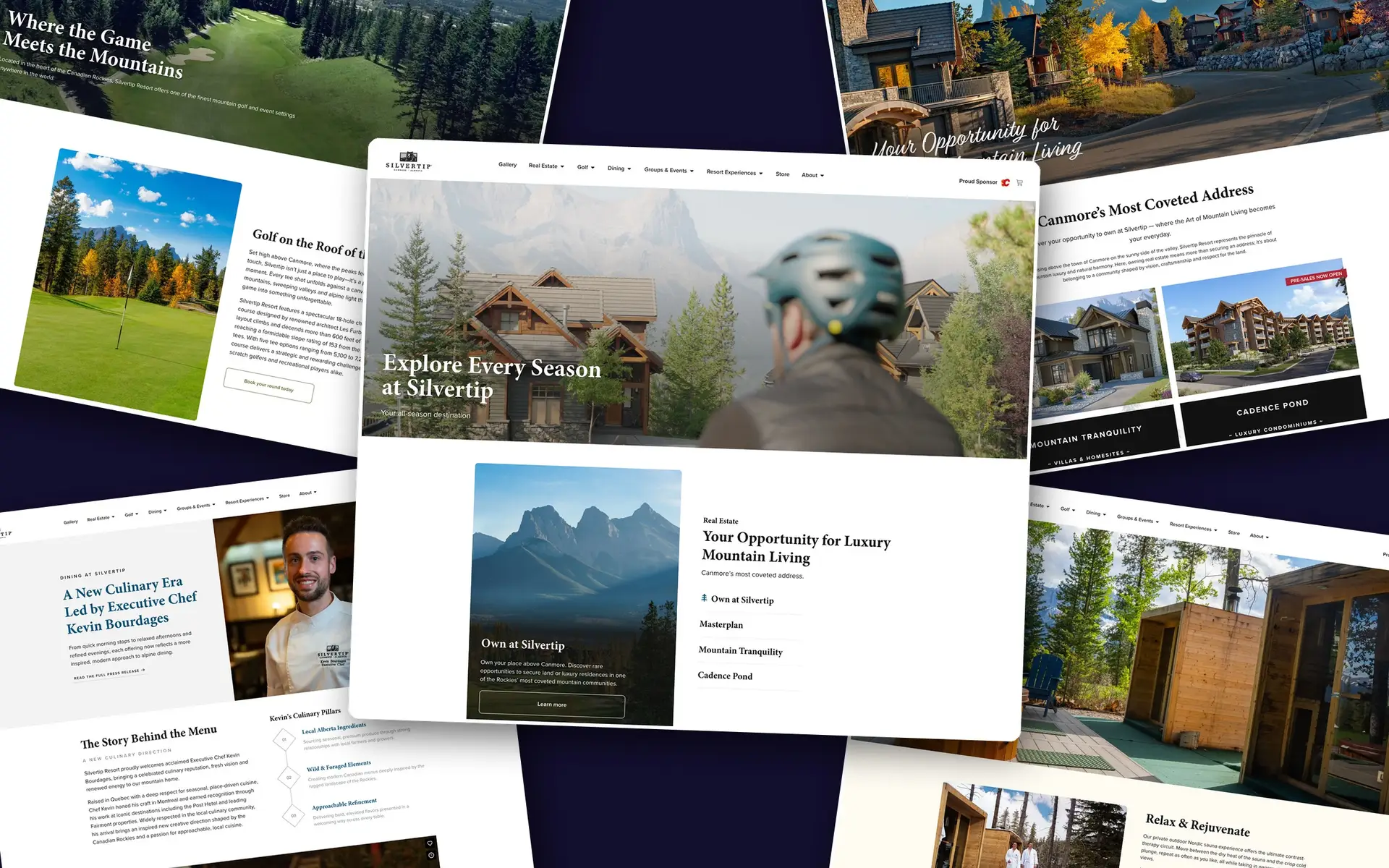
Why Silvertip Resort needed a website rebuild
Before the Silvertip Resort website rebuild, the site had grown old alongside the business it represented. Built on a dated WordPress stack with a heavy page builder and a pile of plugins, the site was slow, prone to crashing, and difficult for the client’s team to update with any confidence. Years of incremental additions had left the information architecture scattered rather than designed — golf alone was split across four disconnected pages covering the course, awards, the practice facility, and the golf academy, forcing visitors to piece together the full picture themselves.
Borrowing a brand that was already on the shelf
The project grew out of ongoing work — we’d been maintaining Silvertip’s old site and building new pages for some time, and it became clear that patch-and-repair had a shelf life. We recommended a full rebuild to future-proof the platform, and Stone Creek Resorts agreed. We started with a new sitemap and wireframes, followed by homepage mockups and a design system built around the brand colors already established in Silvertip’s print work — golf, dining, real estate, and resort experiences each had their own identity on paper, but none of it had ever made it to the web. Bringing that existing brand logic online gave every section of the site its own visual identity without inventing anything new; it just took someone connecting the dots.
Rebuilding golf from four pages into one
Once the design was approved, we rebuilt the site from the ground up on Elementor Pro, moving the client off their old, plugin-heavy WordPress setup and onto a leaner, more client-friendly platform. Content came largely from the existing site, migrated and refined page by page — blog content was scripted over, but every new page was built by hand to take advantage of the new architecture. Golf became the clearest proof of what the rebuild could fix: four scattered pages covering the course, awards, the practice facility, and the golf academy became a single, well-organized “About Our Course” page that finally told one coherent story.
Fixing the foundation, not just the paint
Alongside the rebuild, we addressed the performance problems at their root. The slowness and frequent crashes turned out to be a stack of small problems rather than one big one — a shared server doing double duty for multiple client sites, a plugin list that had grown unchecked over the years, and a page builder that hadn’t been used efficiently. Fixing it meant upgrading the hosting, cutting the plugin count down, and rebuilding with an eye toward keeping things lean. HubSpot forms and CRM connections were layered in near the end of the project, once the design and structure were locked, and QA happened in close collaboration with the VP of Marketing and her team before launch.
Building for the seasons
Resort sites also come with a wrinkle a lot of other builds don’t: the content genuinely changes with the seasons, as golf shuts down in the winter while ski and other cold-weather activities take over. Keeping that seasonal rhythm in mind shaped how flexible the new page templates needed to be. This project was also a good one for sharpening our own process — working inside Elementor Pro at this scale surfaced better ways to share templates and reusable elements across a large site, a workflow improvement that’s already paying off on projects since.